Revolutions of the Luminaries
Was an advanced lunisolar
system within the knowledge
of early astronomers?

May 31, 2013 (+7)
Copyright © 2007-2022
James D. Dwyer
Email: [email protected]
Reference: www.design-of-time.com
You may freely copy or distribute
this material. (Not to be sold).
_______________________
Introduction
A book attributed to an antidiluvian patriarch named Enoch appears to have been in circulation throughout the era of the 2nd Temple. It is here signficant that passages from it were copied into the works of period authors. In fact, a portion of text from the book of Enoch can even be found in the New Testament book of Jude. This ancient patriarch (Enoch) was also held in high esteem by other authors of the New Testament. A rather obvious example can be read from those Gospel accounts that have a 'Son-of-Man' title applied to Jesus. (Note in period literature 'Son-of-Man' is a title that was likewise assigned to Enoch).
For some reason writings attributed to Enoch no longer remained in mainstream circulation by the time of the European Renaissance. However, a somewhat questionable book (presummed to have been authored by Enoch) was rather recently discovered to still be in circulation (in Ethiopia). The Ethiopian version does, in fact, contain a number of axioms and formulas that pertain to resolving the courses of the Earth and Moon. Of significance here is that certain among the definitions and laws recorded in the astronomical section of the Ethiopian texts actually are correct in depicting that rates of lunar quarters, solar months, and tropical years can all be identified together within the context of a rational model (an intelligent lunisolar system). The indication that portions of the Ethiopian Enoch are fully valid in representing the orbital configuration of the Earth and Moon is perhaps one of the reasons why this book was so popular throughout the era of the Temple.
Of significance to this study of ancient astronomy is that portions of the Ethiopian literature (those that accurately account for Sun and Moon stations) also seem to be mirrored from within passages of Hebrew scrolls and books that were published in the era of Temple.
Subsequently presented paragraphs and linked literature will then attempt to document the substance of an early used lunisolar system from out of the pertinent Hebrew and Ethopian texts. A reader will be led to ulimately conclude that an effective 'day count' system for tracking time was almost surely within the knowledge of a segment of ancient astronomers.
Astronomy of Enoch
A historical sketch of Enoch appears in writings authored by Bar-Hebraeus. This medieval author's account of the life and times of Enoch appear to represent a compendium that was drawn from a number of more ancient sources. According to this respective author, Enoch was also the first to have "discovered the knowledge of the Zodiac, and the course of the Planets".
The occupation of Enoch as a priest is only hinted at from amid the various texts attributed to Enoch's own authorship. However, some considerable degree as to the scope and effectiveness of his service in a priesthood office seems to be mirrored from certain passages of early-written literature. In example, Enoch is shown to have "... appointed festivals for sacrifices to the Sun, at each of the Zodiacal Signs". Enoch is further shown to have taught men "to worship God... to fast... pray... give alms, votive offerings, and tenths". Enoch "reprobated inappropriate foods and drunkenness" (Bar-Hebraeus).
Enoch; as an astronomer of note, and as a significant religious leader; seems to also be mirrored in certain Sumerian chronicles--where in "critical scholarship, Enoch is regarded as being a character based on the... myth of Enmeduranki" (Wikipedia). This title or name appears in the Sumerian king list. "[Surviving] records pre-date the authorship of the torah by some 1000 years, [and tell]... of a great priest... of the sun-god Utu. He, in the myth, was subsequently taken by the gods Shamash and Adad, to heaven, and taught the secrets of heaven and of earth. Enmeduranki was extemely significant to the Sumerians, as he was the ancestor from whom all priests had to be able to trace descent, in much the same way as Aaron was to the Aaronid priesthood of ancient Judaism... " (ibid).
Pages of history thus portray Enoch to have been both an accomplished astronomer, as well as a ranking cleric. It here seems of some certain significance that this respective priest-astronomer is unilaterally shown to have been the very first to interpret a lunisolar system on the basis of a set of laws pertaining to the spin and orbital rates.
Writings attributed to Enoch
An entire section of the Ethiopian version of the book of Enoch (from chapter 71 to chapter 82) has a focus upon "the revolutions of the heavenly luminaries". (The cited portion of text that attempts to mathematically quantify the spin and orbital phenomenon is known as Enoch's astronomical book).
To begin to illustrate the kind of lunisolar system that must have been understood by Enoch, a number of its features are recorded in the introductory section of the Ethiopian verstion of his astronomical book--as follows:
"[Chapter 72] The book of the courses of the luminaries of the heaven, the relations of each, according to their classes, their dominion and their seasons... according to their months... and how it is with regard to all the years of the world and unto eternity... " (English translation by Charles).
As is further shown below, the Ethiopian texts can ultimately be understood to outline a lunisolar system that is rational in its design.
Significance of Time Stations
An English translation by Laurence is useful for illustrating that early astronomers would have held knowledge of 'time stations'. To be more specific, there is indication from the Ethiopian Enoch that the ancients time tracked both a station of the Moon, and also a station for the Sun:
[Chapter 71:] "The book of the revolutions of the luminaries of heaven, according to... their respective periods... and their respective months... according to every year of the world for ever... ." [Skipping to Chapter 73:] "... I beheld their stations... according to the fixed order of the months the Sun rises and sets... thirty days belonging to the Sun... [All the days belonging to each year can be correlated to a fixed number of days]... to the Sun and stars... thirty days belonging to them... The Moon brings on all the years exactly, that their stations may come neither too forwards nor too backwards a single day; but that the years may be changed with correct precision in [a fixed number of] days... The year then becomes truly complete according to the station of the Moon, and the station of the Sun... which rise and set in them for thirty days."
From the Enoch literature, it is apparent that the ancients did once time track a "station of the Sun"--probably in association with a cycle of 30 days. Portions of text from the astronomcial book also make it clear that a "station to the Moon" was time tracked inside of the year cycle.
Based upon an hypothesis that Enoch's numbers could pertain to a valid lunisolar system; and to better illustrate the use and definition of a station of the Sun; certain portions of Enoch's astronomical book (Chapter 73) can be interpreted/paraphrased--as follows:
-
One in 30 days belongs to the Sun.
To the Sun and stars, one in 30 days belongs to them.
The station of the Sun (or one day) reappears in a cycle of 30 days.
The indicated description of a station or a day of the Sun seems significant, and the detail is ample enough to point to the ancient use of the following axiom or time formula:
The revolutions of the heavenly luminaries define a station or day that pertains to the Sun. This station or day reoccurs in a cycle of 30 days (an endless rate).
It is pertinent that--in addition to a station of the Sun--Enoch's astronomical book also describes an associated station of the Moon.
"The year then becomes truly complete according to the station of the Moon, and the station of the Sun" (ibid).
According to the astronomical book, in addition to a station of the Sun, a station of the Moon also belongs among (pertains to) the revolutions of the heavenly luminaries.
It is here of significance that other portions of the Enoch literature tend to indicate that the cited station or day of the Moon might have been tracked in place, or in position, with a sequence of the lunar quarters.
Note that the Moon travels through four distinct quarter phases in each synodic period. The four distinctly defined phases are: 1. New phase (when the Moon is fully dark); 2. First-quarter phase (when the Moon is half dark and half light); 3. Full phase (when the Moon is full of light); and 4. Last-quarter phase (when the Moon is half light and half dark). Each of the cited quarter phases of the Moon can be predicted to elapse in a time-span that is approximately equivalent to seven and one-third days.
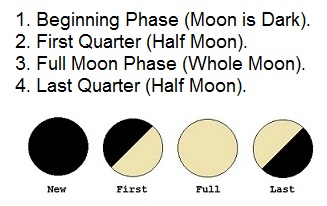
This positioning of a station or day of the Moon in correspondence with a cycle of the lunar-quarter phases is easy to interpret from the following portions of the cited astronomical book: "(Chapter 72: verse 3)... [the Moon's] light is a seventh portion from the light of the Sun.... (verse 6) Half of it is in extent seven portions... its light is by sevens... (verse 8-10) On that night, when it commences its period... it is dark in its fourteen portions... During the remainder of its period its light increases to fourteen portions [or the Moon's light increases to fourteen portions]... (Chapter 73: verse 4) In each of its two seven portions it completes all its light [or the Moon reaches the phase of full illumination in two seven portions]... " (refer to 'The Ethiopian Enoch', by Laurence).
A more indepth research of Enoch's astronomical book leads to the ultimate conclusion that the cited station or day of the Moon was probably tracked in association with a cycle of 7 lunar quarters or 7 lunar weeks. The clue to coming up with a more explicit definition of the station of the Moon from the astronomical book can seemingly be found in Chapter 73 in the portion of text that provides detail of the Moon and its lag of 50 days. ("To the Moon alone... it has fifty days..."). It is here of considerable significance that a cycle of 7 lunar quarters or 7 lunar weeks can effectively be counted out in correspondence with a span of 50-days--as is further shown below.
It can thus ultimately be concluded that primal priest-astronomers might have once reckoned lunar weeks and were knowledgeable of a station or day of the Moon (in addition to the cited station of the Sun). The station of the Moon appears to have been tracked in correspondence with a time-span of 7 lunar quarters or 7 lunar weeks.
The description of a station or a day of the Moon from the Enoch texts is then additionally significant and tends to indicate the early use of the following axiom or time formula:
The revolutions of the heavenly luminaries define a station or day that pertains to the Moon. This station or day reoccurs in a cycle of 7 lunar weeks (an endless rate).
Note that priest-astronomers throughout the ancient Middle East are indicated to have once specially reckoned a cycle of 7 weeks (probably 7 lunar weeks). For additional information concerning the early reckoning of a lunar-week cycle, refer to the following online publication:
It here becomes most remarkable that "every year of the world forever" can effectively be determined by applying nothing more than the two cited axioms (those described in Enoch's astronomical book)! Essentially, it is demonstrable that the rate of the solar year can effectively (perfectly!) be measured and metered out through the time track of a station (a day) of the Sun and a station (a day) of the Moon.
Through the continual reckoning of the two cited stations, the rate of the solar year can precisely (perfectly!) be correlated to a specific number of day units.
Hint: The rate of one day in each month-like cycle of 30 days is inherently equal to 12.17474 days per year (as an average rate). Also, the rate of one day in each cycle of 7 lunar weeks is inherently equal to 7.0676 days per year (on average). These two rates of days (as stations) are then equal to a composite rate 19.24232 days per year. Thus, as long as 19.24232 days or stations per year (on average) are reckoned apart from all other days then it becomes possible to determine the limits of each passing solar year in correspondence with a number count that is always equal to 346.000 of the other days. Note that the rate of the solar year of 365.242 days minus the cited rate of stations (19.242 days) is equal to 346.000 days.
It then seems clear that certain among the axioms and time formulas written down in Enoch's astronomical book are remarkably accurate. The solar circle (365.24219 days) inherently does contain a station or day of the Sun (one in a 30-day cycle) and also a station or day of the Moon (one in a cycle of 7 lunar weeks).
Thus, it seems significant to a study of Enoch's astronomical book that--as long as the cited stations of the Sun and Moon are routinely tracked apart from the other days--the length of each passing solar year is inherently metered into 346 equal divisions--on average. (Note that each of the cited 346 divisions inherently corresponds with the boundary of an exclusively counted day).
It is here very significant that the reckoning of 346 specific divisions (as exclusively counted days) results in a time span that is exactly equivalent to the length of the annual circle or year (in average time). Essentially, 346 days--when counted in association with 19.24232 renewal days per year--is equal to 365.24232 days. Thus, the annual result of routinely leaping the count of each station (or day) of the Sun and each station (or day) of the Moon is a time span that is exactly equal to the length of the annual circle or solar year (on the average). The average annual result of tracking 346 days in correspondence with stations of the Sun and Moon is perfect to within an annual difference of only 11.2 seconds! Remarkable is that the annual result of tracking stations of the Sun and Moon can be recognized as fully or absolutely perfect relative to the rate of the solar year only several centuries before. For more information about the accuracy inherent in tracking a station (or day) of the Sun and a station (or day) of the Moon, refer to the following online publication:
Temple Liturgy
Historical records, including biblical, tend to indicate that certain astronomers who flourished in an era well prior to the 1st century would have been familiar with the cited time track of stations.
In example, a passage of text embedded within the book of Jubilees (a book that was written in the 2nd century BCE) can be recited. This respective manuscript relates that the patriarch Enoch was the first among all of mankind to have "recounted the weeks of the jubilees, and made known to them the days of the years, and set in order the months . . . " (Chapter 4, 18; English translation by Charles).
A key phrase that is contained within the cited book of Jubilees is in that reference made to "the weeks of the jubilees". Of significance here is that this respective time unit (within the additional context of the Ethiopian version of Enoch) shows that ancient astronomers held knowledge of a 50-day cycle [= a time unit that was defined and delimited by a 'station of the Moon'].
Another time unit that is mentioned in the book of Jubilees pertains to the "order of months". When this dot of information is additionally connected with definitions contained with the Ethiopian version of Enoch then early held knowledge of a solar month of 30 days is more fully manifested.
The bible books of Genesis, Daniel, and Revelation also have detail of the early use of a solar month of 30 days. More information about a 30-day month is contained in the following online publication:
As far as time tracking jubilee days, writings produced by Flavius Josephus (a Jewish historian of the 1st century) show that Temple priests of that time period did track a 7-week cycle. When describing a harvest calendar that was then followed, Josephus made mention of a 50-day count traversing 7 lunar weeks--as follows:
" . . . when the Sun is in Aries . . . on the 16th day of the [lunar] month . . . they offer the first fruits of their barley . . . When a week of weeks has passed over after this sacrifice . . . on the 50th day, which is Pentecost . . . they bring to God [sacrifices] nor is there anyone of the [subsequent] festivals, but in it [= the 50th] they offer . . . " (Based upon Whiston's translation of 'Antiquities of the Jews', Book 3, Chapter 10, 5-7).
The Josephus record shows that the priests counted out a cycle of 7 weeks AFTER a barley offering was presented (on the 16th day of a specific lunar month). The cited 50-day count did therefore begin on a day that came after the full phase of the Moon.
One of the conclusions that can be arrived at from the detail provided by Josephus is that the end of the 50-day count would inherently have coincided with a quarter phase of the Moon. Furthermore, each of the intervening weeks of the 50-day count can be recognized to have passed in line with a lunar quarter. In essence, the priests can be recognized to have tracked a full cycle of 7 lunar weeks between the first fruits presentation and the feast of Pentecost.
Note that because each lunar week spans a unit of time that is a bit longer than an ordinary week of 7 days then a number count of 50 days can ALWAYS be counted between the end of the 1st day of any given lunar week and the beginning of the 7th day of the 7th lunar week. In essence, 7 lunar weeks is inherently LONGER, or FULLER, when compared with a day count of 7 regular weeks.
____________________________________

       LEVITICAL HARVEST COUNT
    (from the record of Josephus)
____________________________________

A sheaf was waved after 1st full Moon
          1st week counted
          2nd week counted
          3rd week counted
          4th week counted
          5th week counted
          6th week counted
          7th week counted
New grain celebrated at quarter Moon
____________________________________
The indicated priestly adherence to a harvest schedule that was defined by the lunar week can further be recited from a treatise penned by another 1st-century Jewish writer:
"Don't the fruits of cultivated crops and trees grow and come to maturity through the orbits of the Moon . . . ?" ('The Special Laws, Part 2', Philo Judaeus, based upon Yonge's translation).Here, the annual harvest is again shown to have been conducted in coincidence with a span of time that was uniquely tracked. This passage of early-written text does minimally indicate that the annual harvest was NOT scheduled in the context of an ordinary week cycle (of 7 running days).
Other passages from Jewish literature written in the era of the late Temple do likewise show that contemporary priests did then conduct the annual harvest around a lunar-quarter schedule. In example, a passage from 'The Special Laws, Part 1' indicates that members of the priesthood would have been familiar with a harvest itinerary that was predicated upon the phases of the Moon:
"[The Moon] receives the perfect shapes in periods of 7 days--the half-Moon in the first 7 day period after its conjunction with the Sun, full Moon in the second; and when it makes its return again [= after the full Moon], the first is to half-Moon, then it ceases at its conjunction with the Sun . . . the finest grain flour mixed with oil . . . and wine in stipulated amounts [are periodically offered] . . . The reason is that even these are brought to maturity by the orbits of the Moon in the annual seasons, especially as the Moon helps to ripen fruits; grain and wine and oil . . . " (authored by the Jewish writer: Philo Judaeus at about the turn of the Common Era, translation based upon Yonge).
The quoted text from 'The Special Laws' reflects that the author understood the Moon to have some kind of a role in the production of grain, wine, and oil.
It here seems of related significance that quite a number of passages in the Bible do indicate that the beginning of the harvest was specially commemorated; and that the harvest was subsequently commemorated in weekly stages: "[God] . . . giveth rain, both the former and the latter, in his season: he reserveth unto us the appointed weeks of the harvest". (AV text of Jeremiah Chapter 5:24).
As is further shown below, the weeks that were appointed for the harvest (or harvests) were understood to encompass not just a single cycle of 7 lunar weeks--but multiple cycles. To be more specific, the first cycle of 7 weeks was apparently reserved for the production of grain. A subsequent cycle of 7 weeks is additionally indicated from the historical record. (This respective cycle was allocated for the production of wine). Yet a third cycle of 7 weeks is manifested from the ancient texts. (This time span was reserved for the production of oil). Thus, certain of the texts that were produced (and reproduced) in the era of the Temple do show that first fruits of grain, wine, and oil were sequentially processed right in line with a time cycle of 7 weeks.
Perhaps the best example of this cyclical count of 7 weeks can be recited from a portion of 11QTemple Scroll. The following passage is very clear in showing how that the priests would have supervised the production of first fruits (grain, wine, and oil) in concert with multiple cycles of 7 weeks:
"You must count . . . 7 COMPLETE Sabbaths from the day of presenting the sheaf . . . to the morrow of the 7th Sabbath . . . count [50] days . . . [Then] bring a new grain-offering . . . it is the feast of Weeks and the feast of Firstfruits, an everlasting memorial . . . From the day when you bring the new grain-offering . . . 7 FULL Sabbaths . . . count 50 days to the morrow of the 7th Sabbath. [Then present] new wine for a drink-offering . . . Count from that day . . . 7 FULL Sabbaths; until the morrow of the 7th Sabbath count 50 days . . . then offer new oil . . . " (my paraphrase).
The content of the 11QTemple Scroll can be stated to be rare or unique in comparison with most other Hebrew documents (even among those that have been rediscovered). Nonetheless, some rather detailed instructions are given for conducting the first fruits harvest. According to the author (or authors) of this scroll, the processing of new grain, new wine, and new oil required adherence to always a COMPLETE or a FULL count of 7 Sabbaths. For each one of the three harvests, a special day was invariably celebrated right on "the morrow of the 7th Sabbath".
_____________________________________

      SCHEDULING OF FIRST FRUITS
_____________________________________

     1. 7 Sabbaths for New Grain
     2. 7 Sabbaths for New Wine
     3. 7 Sabbaths for New Oil
_____________________________________

An  offering of grain, then wine, and
then oil was presented in the predawn
hours on each one of the 7th Sabbaths
The cited description of a FULL Sabbath count [Hebrew: tamiym] that ended at the break of day on the 7th Sabbath is just about identical to the intervening 50-day count shown in the Bible book of Leviticus (refer to the 23rd chapter). A comparison of the sacrificial rates for the festival of weeks that is listed in Leviticus, Numbers, and in the writings of Josephus tends to confirm that the first fruits type of the feast of weeks was celebrated with an additional rate of sacrifice. Of related interest here is that the 11QTemple Scroll and also 'The Book of Jubilees' do both show that the first fruits were believed to have a dual or a double significance. Each respective festival day was understood to pertain to both the feast of weeks and the feast of the first fruits.
When the content of the 11QTemple Scroll is compared with the content of the Bible, it becomes manifest that the production of grain, wine and oil is also listed in that same order in a number of the Bible passages. The order of grain, wine, and oil can be recited from the following Bible verses: Deuteronomy 7:13; 11:14; 12:17; 14:23; 18:4; 28:51; 1 Chronicles 9:29; 2 Chronicles 2:15; 31:5; 32:28; Ezra 6:9; Nehemiah 10:37; 10:39; 13:5; 13:12; Jeremiah 31:12; Hosea 2:8; 2:22; and there are other verses.
A sequence of 3 festivals, each spaced 7 weeks apart, can also be identified from the following scrolls recovered at Qumran: 4Q325, 4Q326, 4Q327, 4Q394; where English translations can be found in: 'Dead Sea Scrolls A New Translation', by Michael Wise, Martin Abegg, Jr., and Edward Cook. Of significance here is that some of the Qumran scrolls--while they do indicate the track and celebration of 7 weeks in a three-fold sequence--do not indicate that a 50th day was separately counted out. Essentially, the 7-week cycle that was counted at Qumran was predicated upon nothing more than an ordinary week cycle of 7 running days. This then means that the harvest itinerary that was followed by contemporary Temple priests could not have quite been the same as the 7-weeks count that was followed at Qumran. In fact, liturgical interpretations held at Qumran--when compared with interpretations subscribed to by the more traditional priests--point to quite a number of differences. (Most of the indicated differences concern the Temple's adherence to a lunar calendar).
The priestly reckoning of a cycle of 7 weeks (in association with a celebrated 50th day) is shown in the Hagigah Tractate (section 17a) of the Babylonian Talmud. In a note to that section, the translator (Rabbi Abrahams) wrote that the Sadducees understood each 7th day of the Leviticus count of 50 days to be a literal Sabbath. This respective note seems significant for coming to better understand certain opinions and interpretations held by members of the primal Temple priesthood.
Of additional significance here is that a time cycle of 50 days appears to have likewise been tracked in regions of the ancient Middle East (and by cultures other than Israelite). To be more specific, a pentecontad unit [ = the 'h.' or the 'hamushtum'] is listed on various of the recovered cuneiform tablets (some pertaining to the Old Assyrian Period).
More information about the 'hamushtum' is shown in a 20th century publication: 'Origin of the Week and the Oldest Asiatic Calendar', by H. and J. Levvy.
Of special interest here is that the 'h.' or the 'hamushtum' [= probably a period of 50 days] was sometimes used in association with the agricultural cycle--as follows:
-
A time for swinging the sickle [= 7 weeks for New Grain?]
A period for gathering grapes [= 7 weeks for New Wine?].
Season for harvesting figs [= 7 weeks for New Oil?].
The 'h,' or the 'hamushtum' is also sometimes shown in combination with the time of a 'sapattum' (ibid). Please take note here that the term: 'sapattum' would probably have been understood among the ancients to be about equivalent to the English word: 'cease'. What is more certain than the meaning of this term is that the 'sapattum' would have been understood as 'a period of time between the waxing and waning phases of the Moon'.
In summary to the above, writings from the era of the Temple show that the priests would have understood the weeks of the first harvest right in concert with 7 lunar quarters. (Records show it was after a "50 count" of days in the predawn hours that sacred liturgy was enacted by the priesthood).
____________________________________

  CALENDAR OF HARVEST OFFERINGS *

 ----------     -------------------
  OFFERING        TIME OF OFFERING
 ----------     -------------------
 New Grain      7 weeks after Sheaf
 New Wine       7 weeks after Grain
 New Oil        7 weeks after Wine
____________________________________

* - Offerings for grain, wine, and
    oil came after the wave sheaf.
Of significance about the weeks of harvest is that the time in-between 7 lunar weeks is inherently GREATER or FULLER than the length of 7 regular weeks.
As far as the actual scribe (or count) of 7 weeks (of harvest), or 7 Sabbaths, perhaps the best example can be recited from passages of Leviticus--where in Chapter 23 of the Hebrew version, a 7-weeks count was described to begin or to commence with 'mochorath h+shabbath' (which is presumed to mean the morrow of the Sabbath):
"Your scribe or number ('caphar') must extend from the morrow ('mochorath') to the Sabbath (h+shabbath) . . . " (Leviticus 23:15).
From this beginning or origin, it was essential that a number count encompass a time span equal to 7 whole Sabbaths: " . . . 7 Sabbaths shall be whole or entire . . . ". (Note here that the Hebrew Bible includes the word 'tamiym' to designate a Sabbath that is wholly or fully counted).
A new ('chadesh') offering was ultimately presented on the next 'mochorath' after 50 numbered days. (Only after a full or a complete count had been accomplished was a special renewal day celebrated).
In scribing (or numbering) a 'full' count of 7 harvest weeks, it here seems significant that early-written texts have detail of an annual count of days that included the reckoning of a station of the Moon as well as the reckoning of a station of the Sun. (For additional information about counting the annual return in the context of time stations, refer to previously presented sections). What is significant here is that when each day of the Sun is never counted as a regular week day then each and every revolution of 50 days can be recognized to inherently keep pace with 7 lunar quarters.
So, the ancients could have effectively metered and measured out each passing tropical year by accounting for Sun and Moon stations (as previously shown) and they could also have accurately charted the return of each quarter phase of the Moon (on average) by accounting for Sun and Moon stations.
Thus, a method of 'day counting' the tropical year and also the lunar quarter (on average) is manifested from a simple method of accounting for those days that correspond with time stations of the Sun and Moon.
Take note here that the cited station or day of the Sun (1 day every 30 days) inherently occupies 3.33333 percent of the time stream. When the count of this day is subtracted from out all the days that occupy the time stream then a count equal to 50 days (on average) can be recognized to straddle a span of time equal to 7 lunar weeks. The cited day or station of the Moon can therefore quite effectively be tracked by simply scribing or numbering a cycle of 50 days (exclusive of the counts of those days that align with the station or day of the Sun).
For more complete information about the accuracy inherent in tracking a cycle of 50 days, refer to the following online publication:
Unlike the record of Leviticus which shows a specific count of "Sabbaths" relative to the time of observing Pentecost, the Jewish historian: Josephus does not spell out that a count of 7 Sabbaths was performed by the priests. Instead, the Josephus record shows that 'count 50' was "called by the Hebrews ASARTHA, which signifies Pentecost".
The typing of the 50th day (as Asartha) by Josephus is significant in the regard that other portions of the Hebrew record show that the occasion of an Asartha would have been understood to correspond with the time of a quarter phase of the Moon. To here be more specific, the observance of Asartha (or Atsereth) can be recited several times from passages of the Hebrew Bible. The holding of an Atsereth in a lunar month is shown in the following passages: Nehemiah 8:18; Leviticus 23:36; Numbers 29:35; 2nd Chronicles 7:9; John 7:37; and also Deuteronomy 16:8. It is very clear from these passages that the Atsereth was celebrated at the turn of a lunar week [= a lunar quarter].
This all means the 50-day count shown by Josephus--a count that terminated right at Asartha-- was surely predicated upon a count of the lunar week (and not a count of the 7-day week).
The cited tradition of celebrating an Asartha Sabbath can be recited from passages of literature that were circulated in the Temple era--as follows:
"He created the sun and the moon and the stars . . . to rule over the day and the night . . . the sun [was appointed] to be a great sign on the earth for days and for sabbaths and for months . . . the 7th day [was made] holy . . . that day is more holy and blessed than any jubilee day of the jubilees . . ." ('The Book of Jubilees', Chapter 2, translation by R.H. Charles).
It is here significant that an unmistakable reference to the celebration of 'count-50-days' or 'jubilee days' was made by the author. A given conclusion from this historic passage of text is that even though the 7th day was interpreted as "more holy . . . than any jubilee day of the jubilees", some certain significance surrounding the Atsereth appears to have well been understood.
Of related significance here is that a passage from 'The Decalogue' (by Philo Judaeus) pertains to information and knowledge of Sabbath time that was held from prior to the turn of the Common Era. A holy Sabbath; according to the respective Jewish author; appears to have been defined by the lunar week:
"The fourth commandment [= of the Ten Commandments] has reference to the sacred 7th day, that it may be observed in a sacred and holy manner. Now some regions keep a HOLY FESTIVAL once in the month cycle [and then] count from the new Moon each SACRED DAY to God; but the region of Judea keeps every 7th day regularly, after each interval of 6 days . . . " (my paraphrase).
Of significance here is the rest (or the Sabbath) of the lunar week appears to have mainly been celebrated throughout the evening hours. In addition, the celebration of the lunar Sabbath mandated an all night vigil (as is further shown below). (During the vigil of the lunar Sabbath, certain foods were avoided; and in particular, meat and intoxicating beverages were refrained from).
The celebration of a vigil in association with '50 count' can especially be recited from passages of 'de Vita Contemplativa' or 'The Contemplative Life'. (This treatise was written by Philo Judaeus at about the beginning of the Common Era). The respective report has a large focus upon the liturgical practices of a communal group known as the Therapeutae or the Healers. This movement was described to have abandoned commercial enterprise in a fuller pursuit of religious study and prayer--as follows:
" . . . [Therapeutae] may be met with in many places . . . [in] both Greece and the country of the barbarians . . . and there is the greatest number of such men in Egypt . . . These men assemble AT THE END of 7 weeks, venerating NOT ONLY the simple week of seven days . . . it is a prelude and a kind of forefeast of the greatest feast, which is assigned to THE NUMBER 50 . . . They come together clothed in white garments . . . And in those days wine is not introduced, but only the clearest water . . . And the table, too, bears NOTHING WHICH HAS BLOOD . . . the young men bring in the table which . . . was placed that MOST HOLY food, the leavened bread, with a seasoning of salt, with which hyssop is mingled, out of reverence for the sacred table, which lies thus in the holy outer temple . . . And after the feast they celebrate the SACRED FESTIVAL during the whole night . . . [Staying] till morning, when they saw the sun rising they raised their hands to heaven, imploring tranquillity and truth, and acuteness of understanding. And after their prayers they each retired to their own separate abodes . . . " (translation borrowed from Yonge).
Of significance about this religious movement is that adherents (who flourished at the turn of the Common Era) are shown to have assembled "in many places". At the 7th week, an all night vigil appears to have routinely been held. The bread and water that was served during the evening banquet was understood to represent "most holy food", and the bread that was eaten is shown to have been mingled with hyssop out of reverence for the sacred table in the vestibule of the Temple. In reference to the set of religious liturgy subscribed to among the Therapeutae, the holding of a vigil in association with '50 count' can also be recited from the almost contemporary record of Acts:
"And in the day of the Pentecost [50 count] being fulfilled, they were all with one accord at the same place . . . " (Acts, Chapter 2).
The Pentecost event recorded in the book of Acts shows that festival keepers were gathered before "the third hour"--or before 9 o'clock in the morning. The chronology that is given thus implies either a very early morning assembly, or more probably, an evening vigil. In either case, a rather large number of festival keepers are indicated to have been up and about (and they were assembled before 9 o'clock on the Sabbath morning).
Josephus likewise noted that Temple priests who were contemporary with the era of the late 2nd Temple followed a prescribed set of religious liturgy. Of significance here is that the commemoration of the 'number-50 feast' is shown to have required the enactment of predawn ceremony:
" . . . at that feast which we call 'Pentecost' as the priests were going by night into the inner temple as their custom was, to perform their sacred ministrations . . . ". (Quote borrowed from Whiston's translation of Wars, Bk.6:5:3).
The ancient custom of routinely celebrating an all night vigil at the distance of 7 weeks--even in modern times--continues to be celebrated among priests of the Falasha or Ethiopian Jews. For additional information of this priestly vigil, refer to 'The Liturgy of the Seventh Sabbath: a Beta Israel (Falasha) text', by Monica Davis. (Note: The Beta Israel custom is celebrated in association with the traditional 7-day week--not in association with the lunar week).
The indicated assembly for the all night banquet (Asartha) appears to mirror a rather similar all night assembly that is described in the following portion of the New Testament:
"And upon the One-to-the-Sabbaths [or Greek: Mia twn Sabbatwn], when the disciples came together to break bread, Paul preached unto them, IN EXPECTATION (observance) of the coming of morning; and continued his speech until midnight . . . When he . . . had broken bread, and eaten, and talked a long while, even till break of light had come, they brought the young man . . . " (refer to the Greek language version of Acts, Chapter 20: verses 7-12).
Note that because this assembly was held on the One-to-the-Sabbaths then it is somewhat probable that this event was celebrated in association with the renewal of lunar weeks (or the renewal of months). Of related significance is that several instances of this peculiar date 'Mia twn Sabbatwn' [= the One-to-the-Sabbaths] can be recited from New Testament accounts that have detail of the resurrection of Jesus.
The Christian celebration of an evening rest can, in fact, be recited from Christian literature written as late as the 4th century CE. As an example, Eusebius of Caesarea described how mainstream Christians of his day observed a night vigil in correspondence with a great festival--as follows:
"[Christians observe] a mode of life which has been preserved to the present time by us alone [or by the Christians alone] . . . especially the vigils kept in connection with the Great Festival, and the exercises performed during those vigils . . . [The customs demand] no wine at all, nor any flesh, but water is their only drink, and the relish with their bread is salt and hyssop". ('Church History, Book II').
The peculiar vigil held by Christians at the occasion of a "Great Festival" was also noted by Eusebius to have been a very ancient custom--and THE SAME custom as was adhered to by the Therapeutae.
The most plausible explanation for the holding of a solemn assembly (Atsereth) is probably that this Temple-Era custom was understood to pertain to a covenant that predated the time of Moses. To be more specific, portions of the Genesis record can be recited to substantiate early-held knowledge of an antediluvian covenant. This covenant is perhaps most graphically detailed in the book of Jubilees'--as follows:
"[Chapter 6] And on the new moon of the 3rd month he [= Noah] went forth from the ark, and built an altar on that mountain. And he made atonement for the earth . . . for everything that had been on it had been destroyed, save those that were in the ark with Noah . . . and caused a goodly savour to arise, acceptable before the Lord. And the Lord smelt the goodly savour, and He made a covenant with him . . . And this testimony is written concerning you that you should observe it continually [= perpetually]. . . For this reason it is ordained and written on the heavenly tablets, that they should celebrate the FEAST OF WEEKS . . . to renew the covenant . . . and for this reason they will go wrong as to the new moons and seasons and sabbaths and festivals . . ." (translation borrowed from Charles, my paraphrase).
This everlasting covenant between God and the nations (or Gentiles) is also mentioned in a prophecy recorded in the book of Isaiah--c. 750 BCE--as follows:
"The earth also is defiled under the inhabitants thereof; because they have transgressed the laws, changed the ordinance, broken the everlasting covenant [Hebrew: olam bereeth]." (AV text of Isaiah 24:5).
The everlasting covenant [Hebrew: olam bereeth] that is shown to have been made with the descendants of Noah (the nations) then tends to explain why primal Christians would have tracked and celebrated the renewal of 7 lunar Sabbaths.
Of significance here is that righteous Jews, even those who flourished in the era of the late Second Temple, can be recited to have been mindful of Noah's age-lasting covenant. In example, the presentation of tithes and harvest offerings in pace with time stations of the Sun and Moon can be recited from the writings of Epiphanius of Salamis--as follows:
[The Pharisees] "paid tithes, gave the firstfruits--those of the 30th and those of the 50th days--and rendered the sacrifices and prayers without fail." (Panarion, Against Pharisees, refer to Volume 1, 1:16 by Williams).
In another written passage, Epiphanius left further description of tithes and harvest offerings that likewise were presented in pace with time stations of the Moon and Sun:
"The children of Israel . . . on their departure from Egypt were given God's Law at the hands of Moses himself. The Law God gave them . . . Its teachings were: circumcision; Sabbath observance; tithing . . . ; the presentation of firstfruits both on the 50th and on the 30th days; and to know God alone and serve him." (The Panarion of Epiphanius of Salamis, Judiasm, refer to Williams ).
A better perspective of the presentation of tithes and offerings (presented in pace with time stations) can perhaps more quickly be gained by bringing what has already been presented within the lens of the current focus.
As previously has been shown, it was in the spring season of the year a sheaf of barley was waved by the Temple priests (on the 16th day of the first lunar month). After a time duration of 7 lunar quarters had elapsed, a 'count 50' ceremony (an Asartha) marked the beginning of the wheat harvest. Grain was thereafter allowed to be processed (throughout a duration that lasted for 7 lunar quarters). An Asartha was held again (right at the turn of the 7th lunar quarter) and ceremony was performed to mark the beginning of the grape harvest. Wine was thereafter allowed to be processed (throughout a duration in time that spanned 7 more weeks. An Asartha was again held and ceremony was again performed on the morning of the 7th Sabbath. The harvest of olives was then allowed, and the processing of oil continued for yet 7 more weeks.
This processing of grain, wine, and oil by time segments that straddled 7 full Sabbaths is perhaps most graphically shown on the 11QTemple Scroll. This respective scroll is especially significant in showing that TITHE was SET ASIDE and was kept in store (from the harvest each year). This tithe from a previous year was not allowed to be consumed (once a current year's harvest season had begun).
"On the day of the firstfruits (of grain, and of wine, and of oil) . . . the tithe may be eaten. However, it is forbidden to save any of it over to the next year . . . 1. Grain may be eaten from the day of the firstfruits until the next year (on the day of the firstfruits of grain); 2. Wine may be consumed from the day of the festival (of wine) until the next year (on the day of the festival of the wine); and 3. Oil may be used from its festival, until the next year (on the day of the new offering of oil on the Altar). Any that is left after a respective festival shall then be made holy with fire. After this, it must not be eaten for it is holy" (my paraphrase).
Of significance here is that 3 tithes of the first fruits were set aside: one tithe was set aside for New Grain, one tithe was set aside for New Wine, and one tithe was set aside for New Oil.
This definition of 3 separate tithes does not mean that an amount totaling 30 percent was set aside each year but rather that 10 percent of only the first fruits was vowed to be holy.
Because the first fruits were defined/delimited across rather small time segments (of 7 weeks each) then the first fruits tithe would have totaled only a little over 4 percent of a farmers' annual income.
The cited tithe that was reserved from the first fruits of grain, wine, and oil was set aside to cover the costs of attending annual festivals. The remainder of the annual tithe (other than the first fruits) was set aside for the poor. A good example of the setting aside of the first fruits tithes (or 3 separate tithes) is mirrored in a passage from 'The Book of Jubilees'--as follows:
"[The patriarch] Levi dreamed that they had ordained and made him the priest of the Most High God . . . And Jacob rose EARLY in the morning, on the 14th of this month, and he gave a tithe of all . . . and his father clothed him in the garments of the priesthood and filled his hands. And on the 15th of this month, he brought to the altar . . . his offering, in consequence of the vow which he had vowed that he would give a tenth, with their fruit-offerings and their drink-offerings . . . And Levi discharged the priestly office at Bethel before Jacob his father . . . and he was a priest there . . . [Jacob] tithed again the [second] tithe to the Lord and SANCTIFIED it, and it became holy unto Him. And for this reason it is ordained on the heavenly tablets as a law for the TITHING AGAIN . . . and to this law there is no limit of days for ever. This ordinance is written that it may be fulfilled FROM YEAR TO YEAR . . . and nothing shall remain over from it from this year to the year following. For in its year shall the [wheat] seed be eaten UNTIL THE DAYS OF THE HARVEST OF THE SEED OF THE YEAR, and the wine UNTIL THE DAYS OF THE WINE, and the oil UNTIL THE DAYS OF ITS SEASON. And all that is left thereof and becomes old, let it be regarded as polluted . . . And thus . . . let them not suffer it to become old . . . " (refer to Chapter 7, by Charles).
In a passage of text from 'Questions and Answers on Genesis, Part 3', Philo Judaeus (a writer who flourished at the turn of the Common Era) described the first fruit tithes on New Grain, New Wine, and New Oil--as follows: ". . . after a tenth of the [first] fruits of the earth, of grain, or wine, or oil, has been taken then another tenth is also taken from the remainder . . . "
This passage is significant in that the total annual tithe is shown in two separate portions: 1. A first fruits portion; and 2. A remaining portion.
So, the first portion of the yearly tithe is shown to have been paid in association with the time of growing first fruits (of grain, and wine, and oil). After the first fruits, a second portion of the annual tithe is shown to have been paid. Of significance about the annual tithe then is that the LATTER PORTION of the annual tithe would have been paid only AFTER the first 3 tithes of the year had been set aside.
The remainder of the yearly tithe was given to the poor. However, unlike the second portion of the tithe, or the portion that was given to the local poor, the first tithe was saved to cover the costs associated with attending festivals:
[First Portion:] "Thou shalt truly tithe all the increase of thy seed, that the field bringeth forth year by year. And thou shalt eat before the LORD thy God, in the place which he shall choose to place his name there, the tithe of thy corn, of thy wine, and of thine oil, and the firstlings of thy herds and of thy flocks; that thou mayest learn to fear the LORD thy God always (KJV text of Deuteronomy 14:22-23).
[Second Portion:] "When thou hast made an end of tithing all the tithes of thine increase [after] the third [in the] year . . . [give the remainder of the tithe] unto the Levite, the stranger, the fatherless, and the widow, that they may eat within thy gates, and be filled" (my paraphrase of Deuteronomy 26:12)."
Early-written literature additionally indicates that a law of tithing was at first taught to men by the antediluvian patriarch Enoch. As previously has been shown, Enoch taught men "how to worship God . . . how/when to fast . . . to pray . . . give alms, votive offerings, and tenths". Enoch "reprobated inappropriate foods and drunkenness [= on holy days]" (Bar-Hebraeus).
For more information about liturgy celebrated in pace with time stations of the Sun and Moon, refer to the following online publication:
Classification of days
Texts attributed to Enoch indicate that the ancients would have been familiar with a lunisolar system that was based upon tracking 50-day cycles (as shown). Of additional significance about a day-count system is that early astronomers appear to have understood a system of typing, or classing, certain among the days.
To be more specific about classifying days, the Enoch writings show that some of the days were assigned to represent a station of either the Sun or the Moon, and the writings further show that some of the days were assigned to represent stations of the world. This typing of certain days as 'world stations' is manifested in portions of Chapter 75 of the Ethiopian version:
"These luminaries [the Sun and Moon] truly render service on the world-stations . . . and the exactness of the tropical year is accomplished through its separate [fixed count of] world stations..." (my paraphrase).
What then were 'world stations', and how does a count of 'world stations' relate to "the exactness of the year"?
A simple math analysis proves that the ancients could have counted 173 world stations to perfectly measure and meter every half year cycle, and they could have counted 346 world stations to exactly determine the completion of every full year cycle.
Note here that days counted in association with the revolution of a station of the Sun (1 every 30 days) can be recognized to inherently occupy 3.33333 percent of time, and days counted in association with the revolution of a station of the Moon (1 day every 7 lunar quarters) can be recognized to occupy 1.93504 percent of time. So, if days corresponding to stations of the Sun and Moon are forever tracked then 5.26837 percent of time is inherently accounted for.
It then follows that if 'world stations' are assigned to represent a type, or class, of days (other than belonging within the domain of stations of the Sun and Moon) then this class of days can be recognized to inherently occupy 94.73163 percent of time [where this is the percent of time left over after 5.2684 percent of days are separated].
The genius behind separating a domain of days to occupy exactly 94.73163 percent of time can then be recognized from out of an accounting of 346 of those days.
The tropical year inherently occupies a time span equal to 365.24219 days. So, just how much of this time span is within the domain of 'world stations'? The answer, of course, is 94.73163 percent of the tropical year (which happens to be 345.99988 days).
An accounting of 346 'world stations' (with the addition of stations of the Sun and Moon) thus can be used as an effective 'day-count' method for measuring and metering each tropical year. As shown above, the modern count of 346 world stations comes to within only 11 seconds per year (on the average). Remarkable here is that, due to the slowing spin of the Earth, astronomers who were living in the past would have been able count out the year cycle to within the limits of perfect precision (at about 3 millennia ago).
It here seems pertinent to note that the version of the Enoch writings that we now read shows a number of 364 world stations (rather than a correct number of 346 world stations). The version we now read thus has '3' in the correct hundreds position. However, the '4' and the '6' are in reversed positions (or are incorrectly reversed in the tens and digits positions).
A most major reason for the incorrectly shown number of world stations is probably that a calendar count of 364 days became popular among various Jewish sects who flourished in the era of the Second-Temple.
The incorrect number of world stations that is shown in the Enoch texts we now read thus points to a primal version of the astronomical book in which 346 stations were shown. The original version was then probably modified--or possibly recompiled with other information--by intervening scribes.
Based upon a proven axiom; that the rate of the solar year of 365.24 days can perfectly be measured and metered out through a combinational time track of a station or day of the Sun and a station or day of the Moon; current copies of Enoch's astronomical book seem to warrant substituting the originally written number of world stations (346) for the wrongly copied number of days (364). Consequently, a closer representation (in outline) of the original Enoch is probably reflected in the following reconstructed paragraph:
[Chapter 71:] "The book of the revolutions of the luminaries of heaven, according to... their respective periods... and their respective months... according to every year of the world for ever... ." [Skipping to Chapter 73:] "... I beheld their stations... According to the fixed order of the months the Sun rises and sets... one station or day in 30 days belongs to the Sun... All the remaining days belong to the year... It is the station (or day) of the Moon that brings on all the years exactly so that an annual count of 346 days can be assigned. This count does come neither too forwards nor too backwards by a single day. Through the intercalation of Sun and Moon stations, the years are changed with correct precision. [Chapter 75] ... These luminaries [the Sun and Moon] truly render service on the world stations ... and the exactness of the year is accomplished through its separate 346 world stations ... ".
Regardless of which recreation is believed to more closely reflect the more original version of Enoch, there is hardly any doubt but that primal priest-astronomers were knowledgeable of a station (or day) of the Sun and a station (or day) of the Moon. It seems remarkable that the Sun and Moon stations shown in early-written Enoch texts can be used to effectively (perfectly) measure and meter out the solar circuit.
This all means that certain of the axioms and formulas contained in portions of Enoch's astronomical book (the presumed more original version) appear to be remarkably valid. It is very clear that a nearly perfect definition of the solar year--or 365.24232 days in average time--can be achieved by accounting for the cited lunar and solar stations. Enoch wrote:
" . . . the Sun traverses the heaven, entering into and departing from the portals for thirty days . . . And these are the orders of the stars, which set in their places, and in their seasons and festivals and months . . . each behind a station . . . " ('The Book of Enoch', Chapter 82, by Charles)
Portions of the Enoch writings have additional detail of the intercalation of 4 days that "belong to the reckoning of the year". The days that were intercalated were described by the author(s) of Enoch in ascending order (or in chronological sequence as follows:
" . . . 4 intercalary days . . . belong to the reckoning of the year . . . owing to them men go wrong therein, for those luminaries truly render service on the WORLD-STATIONS, the 1st day in the 1st portal . . . the 2nd day in the 3rd portal . . . the 3rd day in the 4th portal . . . and the 4th day in the 6th portal, and the exactness of the year is accomplished through its separate 364 stations . . . " (Chapter 75, by Charles).
As in other passages of Enoch, this quoted portion of text continues to indicate that primal astronomers did track each passing solar year in pace with a fixed number of world stations. [Note here that the original publication of Enoch did probably show 346 world stations instead of 364 world stations.]
The above quote additionally shows 6 portal stations and 4 seasonal stations, and they are shown as uniformly distributed along/among/amid the world stations.
The cited 4 days that were intercalated are shown to have pertained to the "exactness of the year". The first of these 4 days is shown as being positioned in the first portal, the second of the quarter days is shown at the position of the third portal, the third quarter day is shown in position in the fourth portal, and the last of the days (the 4th day) is shown in the sixth portal (as cited).
The following diagram is predicated upon the location of 4 quarter days each year, and it attempts to illustrate the feasibility of tracking stations to define a zodiac calendar. (Take note that a daycount method is here used to effectively define/delimit 12 specific divisions throughout the tropical zodiac).
---------------------------------------------

 A DAY-COUNT METHOD FOR TRACKING THE ZODIAC *

---------------------------------------------
  Season  Quarter  Zodiac   Month     Portal
  Number    Day    Month     Days      Day
  ------  -------  ------  --------  -------
     1       1        1       28       + 1
                      2       28
                      3       28       + 1
     2       1        4       28
                      5       28       + 1
                      6       28
     3       1        7       28       + 1
                      8       28
                      9       28       + 1
     4       1       10       28
                     11       28       + 1
                     12       28
---------------------------------------------
             4               336       + 6

      Year Total  =  346 World Stations


   * -- This count equals 365.2423 days per
        year when  paced by the addition of
        Sun and Moon stations.
To more clearly illustrate how primal astronomers might have once reckoned 6 portal divisions in each annual circle, the replica of an early-used zodiac calendar is subsequently shown:

Note that the 6 portals--drawn in with yellow marker on the photograph--have been added in an attempt to better show the positioning of the portal divisions relative to the location of the 4 quaters.
If a quarter division of the year was positioned within the 1st, 3rd, 4th, and 6th of the cited gates or portals then a given conclusion is that one of the quarter divisions would have been reckoned from about the middle of the 1st portal. Subsequent quarter divisions would then inherently have commenced in correspondence with the beginning of the 3rd portal... and again the middle of the 4th portal... and yet again at the beginning of the 6th portal.
From the given positioning of the 6 portals relative to the 4 quarters it can be recognized that each of the portals may have been accounted for at the turn of every alternate month.
In Chapter 75, the portals are listed in correspondence with the 4 seasons. Of interest here is that the 2nd, and 5th portals (not listed by the author) would inherently have appeared within the 1st and 3rd seasons (as diagrammed above). Of significance here is that the priest-author may not have listed a 7th portal (a yet additional portal) in association with the 4 seasons. The following diagram is consequently presented to better illustrate this hypotheses:
-------------------------------------

    A Calendar of 49 Fixed Weeks *

-------------------------------------
  Season   Quarter   Annual   Month
  Number    Days      Weeks
  ------  -------   -------  --------
     1       1      7 7 7 7    1
                    7 7 7 7    2
                    7 7 7 7    3
     2       1      7 7 7 7    4
                    7 7 7 7    5
                    7 7 7 7    6
     3       7 ^    7 7 7 7    7
                    7 7 7 7    8
                    7 7 7 7    9
     4       1      7 7 7 7   10
                    7 7 7 7   11
                    7 7 7 7   12
-------------------------------------

* - A 50th day is leaped every 7 weeks
      (= 7 portals days per year)
^ - A week long feast is celebrated
      in the 7th month.
This interpretation sees an annual count of 49 fixed weeks--where a 50th day is leaped every 7th annual week. Throughout the annual accounting of 49 weeks, the occurrence of each Day-of-the Sun (a day occurring at each and every 30 days) must not be counted, as a week day.
The current solar calendar achieves 365.175 days which is minus 0.068 days away from matching the annual transit. Consequently a day would periodically need to be intercalated so as to keep the calendar aligned with the solar year (of 365.24219 days).
Long cycles
The Josephus literature was produced by an author who flourished under the 2nd Temple. Passages of text attributed to this author reveal that period Jewish astronomers held knowledge of the tropical zodiac as well as the Planets. The medieval writer: Bar-Hebraeus, also stated that the ancients held knowledge of the divisions of the Zodiac (and that Enoch was the first to have discovered "the course of the Planets"). So, exactly what did Temple astronomers knew about the Zodiac and the courses of the Planets? . . . and what about lunar and solar elipses? . . . and what about other Earth-Moon cycles?
Of significance here is that certain passages of early-written literature are quite graphic in showing that priest-astronomers of the Temple Era held unusual, even advanced, knowledge of a lunisolar sytem. A very good example can be recited from commentaries about the Genesis record produced in the 1st century by Philo Judaeus (a Jewish writer). This author wrote that the first day of Adam and the first day of the flood of Noah (the Great Deluge) both came on the day of the vernal equinox (or the first day of spring). This piece of information then shows that priest-astronomers understood Earth's orbit to have been positioned identically (relative to the Sun) on both occasions. The Genesis record is additionally significant in showing that the spin of the Earth was belived to have been identically aligned with the lunar period (both at the epoch of creation and also on the day of Deluge).
Please take note here that the time span to the flood (as shown in the Genesis record) is inherently equal to an eclipse cycle of 20482 lunar months. For more comprehensive information about Temple astronomers and about the record of the flood, refer to the following online publications:
Other bible books, as well as certain among the scrolls recovered at Qumran, are rather explicit in reflecting that the Temple priests held knowledge of some very functional lunisolar time cycles. To be more specific, the book of Leviticus shows that a span of 7 sets of 7 years (or 49 years) would have been time tracked among the ancients. After 49 years were counted-out, a special jubilee celebration was held to announce the commencement of the jubilee year (or the 50th year). Of significance here is that the content of certain period manuscripts reveals that the jubilee year may have been celebrated in association with a system of lunar reckoning. As an example, Scroll 4QOtot is explicit in showing the routine occurrence of a lunar-cycle 'sign' in association with a count of the jubilee cycle. (The priests when revolving their courses throughout the jubilee time cycle appear to have reckoned a lunar-cycle 'sign' at a continuous frequency of each 3 years).
For complete detail about the ancient track of a lunar sign, refer to the following online publication:
Ancient astronomer-priests
Enoch is a fascinating book in that the ancient priest-author tells of past history, he warns about Angelic judgment, and the writer forecasts the coming of a new age.
A most mind riveting facet that shines from the writings produced by Enoch, and from other bible authors, is the detail given of various amazing encounters with an Angel (or Angels). In fact, many passages are largely an account of visions the author received ... as well as a record of the words that were spoken by a Divine Messenger.
Irregardless of whether the Temple Era record might actually stem from a source that is Supreme, the writings of Enoch remain to be significant because the astronomer-priest is shown to have come to recognize a lunisolar system in which the courses of the luminaries (the Sun, the Moon, and the stars) can be defined within the context of counting cycles of days. Of additional significance here is that Enoch appears to have learned to type or class the days, and to assign them to a specific domain (stations, months, seasons, and years).
So, from a trail of literature that was produced by primitive astronomers, it is very easy to illustrate that the orbital returns of the Earth and the Moon can effectively (even perfectly!) be measured and metered out in the context of nothing more than performing day counts.
For more information about early priests and ancient astronomy, refer to the following online publications:
Please feel free to download and distribute this article, or any of the articles and booklets listed above. (Note that the published material is subject to constant revision. Be advised that corrections, amendments, and new interpretations are frequently made.)
Copyright © 2007-2021 A-Quest-For-Creation-Answers